

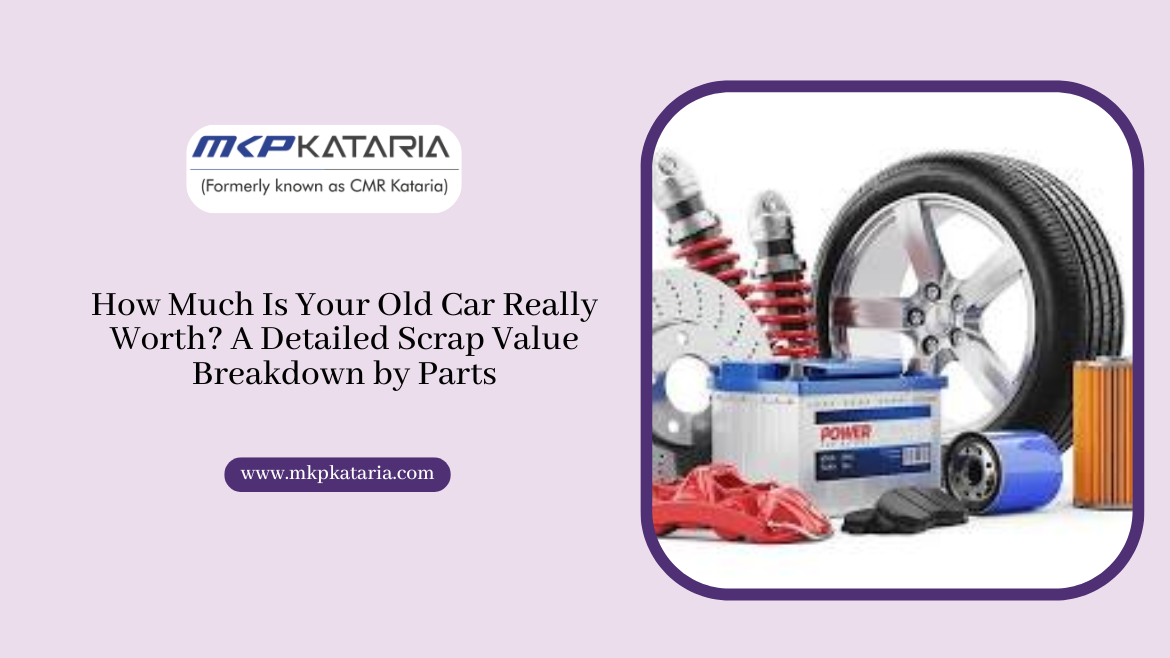
When a vehicle reaches a point where fixing it feels never ending and resale value has faded away, scrapping often becomes the sensible option. Many car owners assume that scrapping means accepting whatever price is quoted by car scrap companies in India. This assumption frequently leads to dissatisfaction. An old car is not a single worthless item, it is a mix of materials and components that still carry real value when dismantled properly. This article explains how the scrap value of an old car in India is generally split across its main components.
How Scrap Valuation Normally Takes Place
Scrap valuation is not as random as it sometimes feels. A car is not priced just because it is old. Age alone rarely decides anything. What matters is what can still be taken out of the vehicle. Weight plays a role. So does the amount of metal inside it. The condition of the engine, gearbox, and other major parts also affects the number. If certain components can be reused, that helps too.
Once dismantling starts, everything does not go to the same place. Some parts are removed and sold again. Others are broken down only for metal. A few items are sent directly for recycling under approved systems.
Wheels and Tyres Contributing About 5 to 6 Percent
The type of wheels fitted to a car plays an important role in this category. Alloy wheels hold more value because aluminum typically sells at higher rates than steel. Steel wheels still contribute, but at a comparatively lower level. Tyres themselves do not offer high recycling returns, yet they remain part of the overall calculation. Missing wheels or badly damaged rims can reduce this share.
Engine and Gearbox Contribution at About 30 to 35 Percent
The engine and gearbox usually decide most of the scrap value. They are heavy, metal rich units, and that alone makes them important, even when they no longer work. An engine does not need to be running to be valuable. Its casing, inner parts, and sheer weight still count for a lot. The gearbox works in much the same way.
In some cases, smaller components are removed and used elsewhere instead of being melted down. Diesel engines often sit higher on the scale, mainly because they are built tougher and weigh more.
Body Shell and Chassis Making Up Around 25 to 30 Percent
The body shell and chassis account for a large share of scrap value because they are made primarily of steel. Cosmetic damage does not reduce their worth significantly, since recycling focuses on raw material recovery rather than appearance.
Exhaust System and Catalytic Converter at Roughly 8 to 10 Percent
One of the most underestimated parts of a car is the catalytic converter. It contains trace amounts of precious metals that are extracted and reused. This alone makes it a meaningful contributor to scrap value. The rest of the exhaust system adds additional recyclable material.
Electrical Wiring and Electronics at Around 5 to 7 Percent
Cars today have heavy networks of wiring and these wiring harnesses are rich in copper, which significantly boosts their scrap worth. In addition, electronic units such as control modules and sensors may still be reusable. If the electrical components of the modern cars are intact, they have higher worth as they have advanced electrical systems.
Radiator and Air Conditioning Components at 4 to 5 Percent
Radiators and air conditioning parts quietly add to scrap value due to their aluminum and copper content. Condensers and compressors are dismantled for both material recovery and reusable components. Even when the cooling or air conditioning system is non functional, these parts retain value because of the metals involved.
A General Look at Scrap Value Distribution
In most cases, the engine and gearbox make up the largest share, contributing roughly 30 to 35 percent of the total value. The body shell and chassis usually follow at around 25 to 30 percent. The exhaust system, along with the catalytic converter, adds about 8 to 10 percent.
Interior Parts and Scrap Value
Conclusion
Scrapping a car is rarely as simple as handing it over and taking a fixed amount. Some parts matter more than others, and some barely move the number at all. Interior components fall into that second category, but they are still checked and considered. Knowing this helps set expectations before you speak to a dealer. Prices will differ from place to place and car to car, but understanding how value is spread makes the process feel less uncertain and easier to deal with overall.