

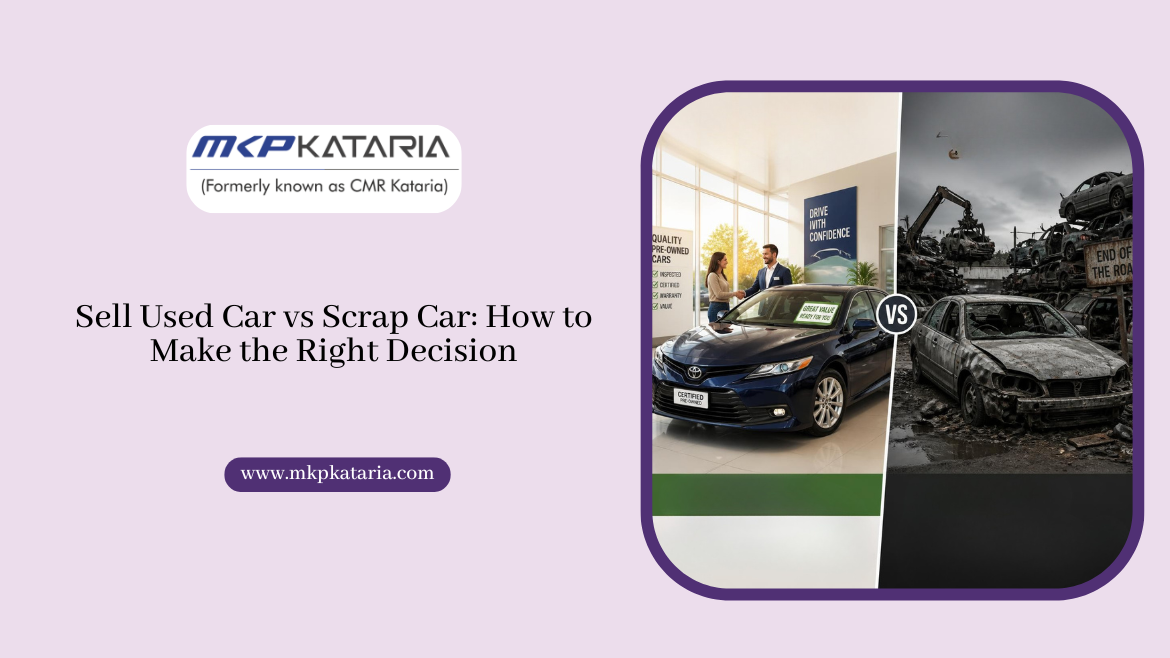
Every car eventually reaches a stage where owners must decide whether to sell it as a used vehicle or send it for scrapping. While a well-maintained car can fetch a good resale value, an ageing or heavily damaged vehicle may be better suited for recycling through an authorised scrapping centre.
Making the right decision depends on several factors, including the car’s age, condition, repair costs, market demand, and legal compliance. Understanding the differences between selling and scrapping can help you maximize value while avoiding future complications.
In this guide, we’ll compare both options to help you determine the best choice for your vehicle.
When Should You Sell a Used Car?
Selling your car is often the right option if it is still roadworthy and has good resale potential.
A used car usually attracts buyers when it:
- Runs smoothly
- Has a valid Registration Certificate (RC)
- Meets emission norms
- Has regular service records
- Has no major accident history
- Requires only minor repairs
If your vehicle is relatively new and still in good condition, selling it privately or through a dealer can provide a better financial return than scrapping it.
Benefits of Selling a Used Car
Higher Resale Value
A well-maintained vehicle generally commands a better price than its scrap value.
Wider Buyer Market
Used cars remain in demand among first-time buyers, students, families, and businesses looking for affordable transportation.
Faster Return on Investment
Instead of investing in further repairs, selling allows you to recover a significant portion of your vehicle’s remaining value.
Easier Upgrade
Many owners sell their existing vehicle to finance the purchase of a newer model.
When Should You Scrap Your Car?
Scrapping becomes the better option when the vehicle has reached the end of its useful life.
Common situations include:
- Severe accident damage
- Engine failure
- Extensive rust or corrosion
- Frequent mechanical breakdowns
- High repair costs
- Poor fuel efficiency
- Failure to meet pollution standards
- Expired registration with costly renewal requirements
If repairing the vehicle costs more than its actual market value, scrapping is usually the more practical choice.
Signs Your Car Is Ready for Scrapping
Several warning signs indicate that your vehicle may no longer be suitable for resale.
Repair Bills Keep Increasing
Constant maintenance expenses can quickly exceed the car’s resale value.
Major Structural Damage
A badly damaged chassis or frame often makes repairs uneconomical.
Poor Emission Performance
Older vehicles that fail pollution tests may become difficult to register or legally operate.
Lack of Buyers
Some ageing vehicles have little or no demand in the second-hand market.
Safety Concerns
Worn-out brakes, suspension, steering, and engine components can make driving unsafe.
Comparing Selling and Scrapping
|
Factor |
Sell Used Car |
Scrap Car |
|
Vehicle Condition |
Good |
Poor |
|
Resale Value |
Higher |
Based on scrap material |
|
Repair Requirement |
Minimal |
Usually extensive |
|
Buyer Availability |
Good |
Not required |
|
Environmental Impact |
Neutral |
Positive through recycling |
|
Documentation |
Ownership transfer |
Scrapping certificate and RC closure |
Financial Considerations
Many vehicle owners focus only on resale value, but long-term costs should also be considered.
If your car requires:
- Frequent engine repairs
- Expensive spare parts
- Transmission replacement
- Suspension overhaul
- Major electrical work
the overall ownership cost may become much higher than the amount you could recover by selling it.
In such cases, scrapping helps avoid recurring expenses while allowing valuable materials to be recycled responsibly.
Environmental Benefits of Scrapping
Old vehicles contribute significantly to:
- Air pollution
- Fuel wastage
- Carbon emissions
- Hazardous waste
Authorised vehicle recycling facilities safely dismantle vehicles by recovering metals, plastics, glass, and reusable materials while disposing of harmful fluids responsibly.
This process supports sustainable manufacturing and reduces the need for extracting new raw materials.
Legal Advantages of Vehicle Scrapping
Selling a vehicle privately requires ownership transfer to the new buyer.
If this process is not completed properly, the original owner may continue to face legal risks.
Vehicle scrapping offers a more secure alternative because:
- Registration records are updated.
- The vehicle is permanently removed from circulation.
- Ownership is officially terminated.
- Required documentation is issued.
This provides peace of mind that the vehicle will not be misused in the future.
How Vehicle Age Affects Your Decision
Although age alone does not determine whether a car should be sold or scrapped, it is an important factor.
Generally:
Cars Under 8 Years
Usually have strong resale demand if maintained properly.
Cars Between 8–15 Years
May still attract buyers depending on condition and service history.
Cars Above 15 Years
Often require costly maintenance and may face stricter regulatory requirements, making scrapping a more practical solution.
Questions to Ask Before Deciding
Before making your decision, consider the following:
- Is the vehicle still safe to drive?
- How much will future repairs cost?
- Does it meet current emission norms?
- Can you find a genuine buyer?
- Will resale provide better value than scrapping?
- Are replacement parts becoming difficult to obtain?
Answering these questions will help you make a financially sound decision.
Choosing a Reliable Scrapping Partner
If you decide to scrap your vehicle, always choose a government-authorised recycling facility.
A reliable facility will:
- Verify ownership documents.
- Offer transparent vehicle valuation.
- Safely dismantle the vehicle.
- Recycle materials responsibly.
- Provide necessary scrapping documentation.
- Assist with registration closure where applicable.
Avoid handing your vehicle to unverified scrap buyers who may not follow proper legal or environmental procedures.
If you’re searching for trusted car scrap dealers in ahmedabad, ensure they operate through an authorised vehicle scrapping centre and provide complete documentation for a safe and compliant process.
Final Thoughts
The decision to sell or scrap your car depends on its condition, age, repair costs, and overall market value. If your vehicle is still reliable, safe, and in demand, selling it as a used car can provide a higher return. However, if it has become unsafe, expensive to maintain, or no longer meets regulatory standards, scrapping is often the smarter and more responsible option.
By carefully evaluating your vehicle and choosing the right disposal method, you can maximise its value while ensuring legal compliance and contributing to environmentally responsible recycling.